
 By
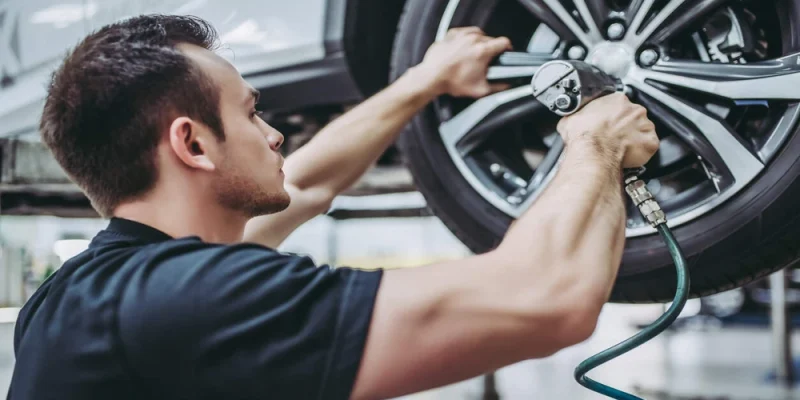
Leave installed wheel-balance weights in place when preparing a car for photographs. Their mass and location serve the tire-and-wheel assembly, rather than a preferred visual arrangement. If a small strip catches your eye, have it identified before treating it as rubbish or finishing residue. Change the picture’s framing, or discuss the concern with a qualified tire professional, instead of altering the assembly yourself.
A newly finished dark wheel can make a small contrasting detail unusually noticeable. At a Toronto photo session, you crouch beside the parked car with a camera and see something behind a spoke that you had never considered before. It looks like the sort of temporary strip normally removed from a new purchase. The apparently simple photographic improvement is to peel it away. That is the moment to establish what it is.
The small strip may belong to the assembly
A wheel photograph contains more than the coloured face. Depending on the design and camera position, it can reveal parts of the wheel’s inner surface and components behind it. Not everything interrupting the colour is leftover packaging. An owner who has only recently become interested in the wheel’s appearance may be seeing an ordinary functional detail for the first time.
Ask the business that performed the work to identify the item. A photograph taken safely from the ground may be sufficient to begin that conversation. Say where it is and what prompted the question, while leaving it attached. There is no need to pull at it to determine whether it is adhesive-backed or to remove the wheel for a better view.
The identification matters because genuine finishing residue and an installed balance weight call for different responses. A general online image can suggest what you are looking at without proving the identity of every piece on your car. If the provider cannot identify it from the picture, agree on an appropriate inspection. Do not make removability your test: something coming off easily would not establish that it was meant to be discarded.
Keep the photographic aim in proportion. A close crop can make a small contrasting object seem like the dominant feature of the car. That does not change its role. The same object may be barely noticeable from ordinary viewing distance, yet important to the assembly’s completed service. Distinguishing those two scales helps avoid turning a styling frustration into a mechanical alteration.
A balance setting is not a visual arrangement
Tesla’s vehicle-maintenance guidance explains wheel balancing as ensuring even weight distribution within the tire-and-wheel assembly. Its 2017-2023 Model 3 balancing procedure provides a more specific example: equipment determines the weights and their positions, and the assembly is checked again. These are technical service decisions, not decorative choices made by arranging visible pieces neatly.
The owner does not need to learn that workshop procedure to understand the implication. Taking away a weight or moving it behind a different spoke changes what was installed. Remembering approximately where it sat does not reproduce the measured result. Nor does putting the same number of small pieces elsewhere preserve the setting merely because their combined appearance looks similar.
If pieces have already been removed, tell the service provider what happened before using the car further and obtain appropriate advice. Keep the removed items available for identification, but do not reattach them from memory or take a high-speed drive to see whether anything feels different. An absence of immediately noticeable vibration would not verify that the assembly remains correctly balanced.
When arranging Onyx Rims’ mounting and balancing service, tell the shop directly: a strip was removed for a photograph, which wheel it came from if known, and whether anything else was disturbed. Ask how the assembly should be assessed and handled now. The technician needs that sequence before discussing what work is appropriate; a request to make the weights less noticeable would conceal the important event.
Where nothing has been disturbed, discuss any appearance preference before future tire service. You can ask whether a suitable option exists for the actual assembly, while accepting that technical requirements govern what can be supplied. Do not assume that a different colour, weight style, or location is available or appropriate. A professional explanation of the constraint is more valuable than a cosmetic promise made without checking.
Also distinguish a question about appearance from a concern about attachment. If an installed item seems loose or a piece has been found near the car, describe that concern and seek guidance. Do not press it back, add glue, or decide which wheel it belongs to by comparing the empty-looking spaces. The response should address the actual condition, rather than recreate a pleasing visual pattern.
Change the photograph before changing the wheel
For a personal photograph, the simplest choice may be to show the wheel honestly with the installed functional detail visible. The picture can still communicate its design, colour and relationship to the car. A close view of real equipment does not have to resemble a catalogue rendering from which every practical detail has disappeared.
You can also change the composition while the car remains safely parked. A wider view may make the body-and-wheel relationship the subject, rather than an isolated area behind one spoke. Another camera position might express the design more clearly. Work around the stationary vehicle without reaching into traffic or moving it solely to conceal an installed item.
If the photograph is for a sale, keep its purpose in mind. Heavy editing that removes actual components can give a buyer an inaccurate impression of what is present. An honest image and a clear account of recent work are more useful than a supposedly perfect detail shot that prompts different expectations at a viewing. Cosmetic presentation should help someone see the car, rather than require the car to imitate the edited image.
Professional photography offers the same basic choice. Tell the photographer that installed components must remain undisturbed and ask them to solve the composition. Do not leave the person preparing the car to infer that every visible strip can be peeled away. A brief explanation before the session protects the completed assembly without turning the shoot into a lesson in tire equipment.
Look again at the picture that started the concern. The small detail is either something the provider has identified for an appropriate response, or a functional weight that stays where the service placed it. Neither outcome needs an owner-made mechanical adjustment. A convincing wheel photograph can include the ordinary evidence that the wheel belongs to a complete, usable car.




Comments