
 By
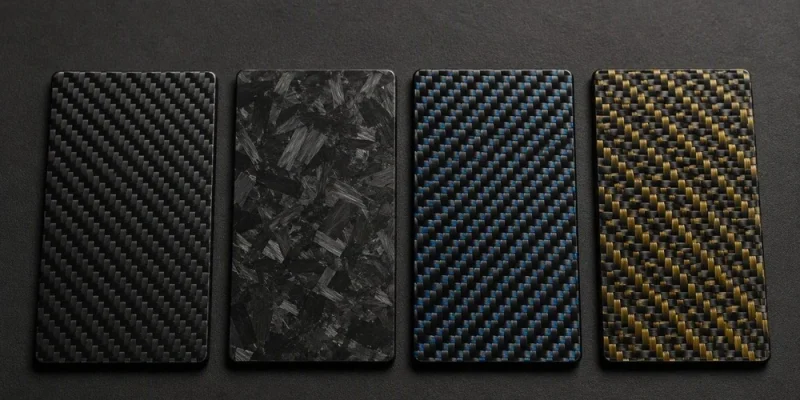
Black is not a paint choice. It is the material itself.
Scroll through any parts catalog and a pattern jumps out: carbon fiber is black. Always black. Not because designers lack imagination, and not because black photographs well, though it does, but because of what the material actually is. Understanding that one fact explains every colored carbon part you have ever seen, and tells you exactly which coloring methods will last and which will disappoint.
The Chemistry of Black
Carbon fiber starts life as a white acrylic-like thread called PAN precursor. Manufacturers then bake it through a stabilization stage around 200 to 300 degrees Celsius, followed by carbonization at 1,000 to 1,500 degrees. Almost everything that is not carbon burns away, and what remains is more than 90 percent pure carbon. And carbon, like charcoal and pencil lead, is black. There is no white carbon fiber hiding somewhere, no natural gray variant. The color is the chemistry, and the chemistry is not negotiable.
This also explains why no dye exists for the fiber itself. Any pigment or dye is an organic compound, and organic compounds do not survive a 1,500-degree furnace. The fiber emerges from the oven already black, already final. You can no more dye carbon fiber than you can dye a diamond. The color is baked in at the atomic level, before the fiber ever meets a loom.
This is why the 7 ways to change carbon fiber color all share one trick: none of them change the fiber. Every method works by changing what surrounds the fiber. The resin, the coating, or the fibers woven alongside it.
What Colored Carbon Actually Is
When you see red carbon, blue carbon, or a gold-flecked weave, you are looking at one of three things. Either the resin holding the weave was tinted, or colored fibers like aramid were woven in next to the carbon, or a coating was applied over the finished part. The carbon underneath is still black. It will always be black. The question is never whether the fiber can be colored. It is which surrounding layer carries the color, and how well that layer survives sun, heat, and time.
The 7 Ways, in Brief
- Gloss clear coat: the classic deep, wet, 3D look. Not a color change, but the finish most people picture.
- Matte clear coat: kills reflections for a stealth, technical appearance.
- Satin finish: the grown-up middle ground between gloss and matte.
- Forged carbon: chopped fiber pressed into a marble pattern, texture instead of weave.
- Hybrid weaves: aramid or other colored fibers woven in, giving gold, red, or blue accents that are structural, not sprayed on.
- Dyed resin: pigment mixed into the epoxy itself, so the color runs through the whole part.
- Paint and wrap: the surface route. Any color you want, over a black base.
Finish Is Not the Same as Color
Here is a subtlety most buyers miss. A matte black carbon hood and a gloss black carbon hood are the same color, but they read as completely different parts. Gloss deepens the weave and throws highlights; matte flattens it into a texture. Before you chase dyed resin or hybrid weaves, decide which finish family you want, because finish changes the perceived color more than most tints do.
The clear coat matters for another reason: depth. A quality gloss clear is applied thick enough to level over the weave, and that glassy layer is what gives show-car carbon its underwater look. Thin clear coats leave the weave texture at the surface. Flatter, duller, cheaper-looking even in the same black. Two parts with identical fabric can look a price class apart on clear coat alone.
What to Ask Before You Order
When a seller offers colored carbon, ask one question: where does the color live? If it lives in the resin or in woven-in fibers, it will age with the part. If it lives in a thin surface tint over clear coat, ask about UV stability and what happens when it chips. The honest suppliers answer instantly. The weaving process itself also affects the final look. The carbon fiber fabrication walkthrough shows how much of the finished appearance is decided before any coating touches the part.
One more practical note: if you are ordering multiple colored parts, say, mirror caps plus a spoiler, order them together from the same batch. Tinted resin and hybrid weaves vary subtly between production runs, exactly like paint lots. Parts made together match; parts made six months apart can be close enough to notice.
Black carbon is not a limitation. It is a canvas with rules. Learn the seven ways around the rules, and you can have any look you want. With your eyes open about how each one is made and how each one ages. Start with the finish, choose the color route with open eyes, and the rest of the decision makes itself.


Comments